
India has officially made the switch to E20 petrol — and it’s one of the biggest changes to hit the country’s fuel landscape in decades.
But what exactly is E20 petrol? Why is the government pushing it so aggressively? And what does it mean for your car or bike? Let’s break it all down.
Table of Contents
What Is E20 Petrol?
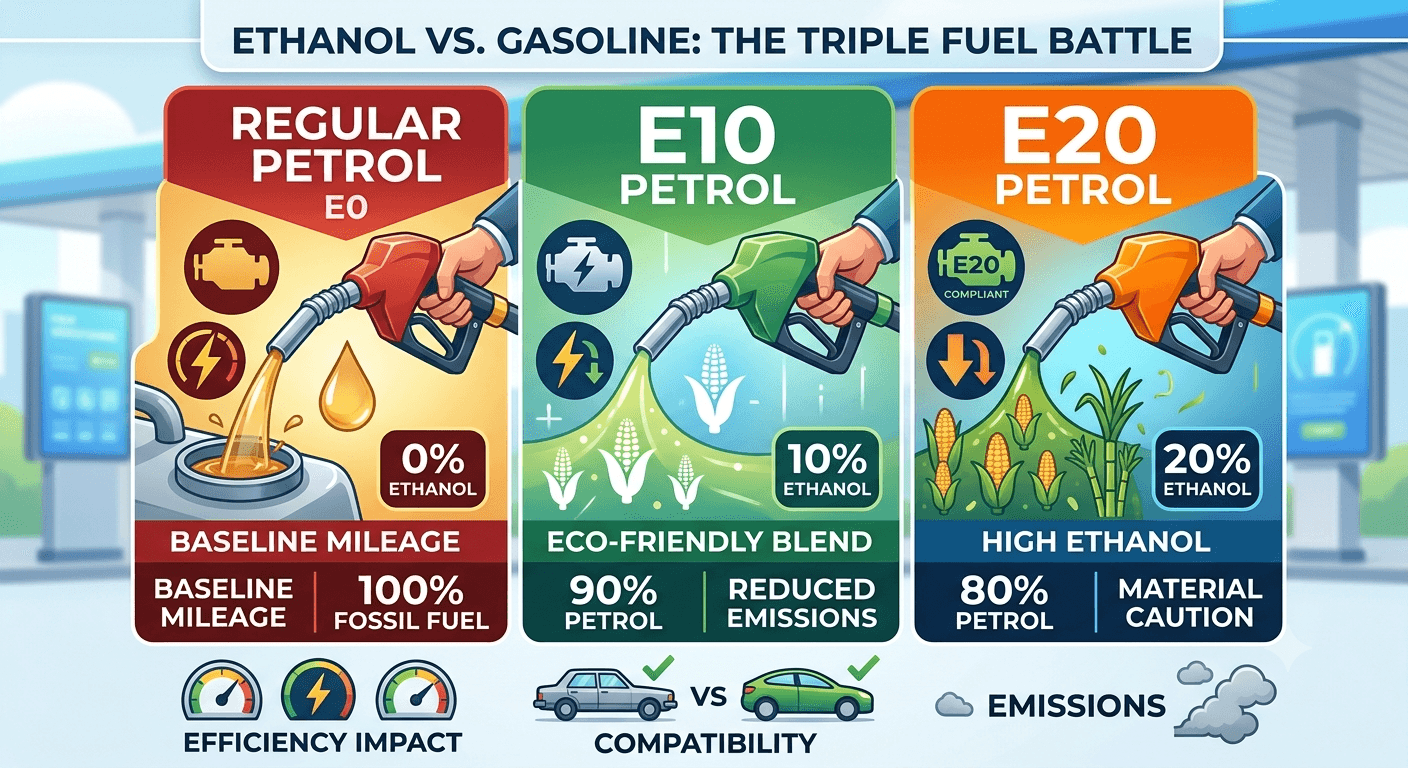
E20 petrol is simply regular petrol blended with 20% ethanol. The “E” stands for ethanol, and “20” refers to the percentage of ethanol in the mix — so you’re getting 80% conventional petrol and 20% ethanol every time you fill up.
Ethanol is an alcohol-based biofuel made by fermenting sugar-rich crops like sugarcane, maize (corn), and even damaged food grains. It has been used as a fuel additive around the world for decades — countries like Brazil and the United States have run on high-ethanol blends, including E100, for years.
India’s journey with ethanol blending started much more modestly. The Ethanol Blended Petrol (EBP) Programme was first launched back in 2001 as a small pilot project. For many years, progress was slow and ethanol production stayed flat. Fast-forward to today, and India has executed one of the most ambitious fuel transitions in its history.
A Quick History: How India Got to E20
India didn’t leap straight from zero to E20 overnight. The government followed a step-by-step blending roadmap:
- 2001 — Ethanol blending pilot programme launched
- 2013–14 — Only 38 crore litres of ethanol blended annually
- June 2022 — India crossed the 10% blending (E10) milestone, five months ahead of schedule
- 2022–23 — Blending rose to 12.06%
- 2023–24 — Blending increased further to 14.60%
- 2024–25 — Blending reached 17.98% by February 2025
- April 2026 — E20 mandated as the national standard fuel
The original target was to achieve 20% blending by 2030. But in 2020, the Cabinet Committee on Economic Affairs advanced that deadline to 2025 — a full five years ahead of schedule — signalling how seriously the government was taking the transition.
Why Is India Making This Switch? The 5 Big Reasons
1. Cutting the Crude Oil Import Bill
As of June 2026, India is the world’s third-largest oil consumer, and the country imports a staggering amount of crude oil every year. This dependence costs India billions of dollars in foreign exchange annually and leaves the economy vulnerable to global oil price swings.
E20 directly reduces how much imported crude oil is needed. By blending 20% domestically produced ethanol into every litre of petrol sold, India significantly cuts its crude dependency. The savings are substantial — ethanol blending has already saved the country ₹43,000 crore annually in oil import costs, and the numbers keep growing.
2. Fighting Air Pollution and Cutting Carbon Emissions
Ethanol burns cleaner than petrol. Studies by NITI Aayog have found that sugarcane-based ethanol produces 65% fewer greenhouse gas emissions than petrol on a lifecycle basis, while maize-based ethanol cuts emissions by around 50%. E20 fuel has also been shown to reduce carbon emissions by up to 10% compared to conventional petrol, along with significant cuts in particulate matter.
For a country battling some of the world’s worst urban air quality — especially in cities like Delhi, Mumbai, and Kolkata — cleaner-burning fuel is not just an environmental choice. It’s a public health necessity.
3. Boosting Farmers and the Rural Economy
Here’s a less-talked-about benefit: ethanol blending has been transformative for India’s agricultural sector. Sugarcane farmers, in particular, have been direct beneficiaries of the programme.
Between 2020 and 2025, the E20 policy channelled approximately ₹45,000 crore into rural incomes. It supports an estimated 5 million sugarcane farmers and has helped the government systematically clear long-pending sugarcane payment arrears to farmers — a problem that had plagued the sector for years. As India increasingly sources ethanol from maize as well, even more farming communities stand to benefit.
4. Better Fuel Performance
This one surprises many people. Ethanol actually has a higher octane rating (~108.5) compared to regular petrol (which has a RON of around 84–91). By blending 20% ethanol into petrol, E20 achieves a minimum 95 RON — a meaningful jump that translates to better engine performance.
For vehicles tuned for E20, this means better anti-knock properties, smoother combustion, and improved acceleration — especially in stop-start city driving conditions. The Ministry of Petroleum has noted that E20 delivers better acceleration and ride quality compared to lower-blend fuels.
Real life experiences differ a lot. Personally I have seen drastic decrease of mileage in all of my three cars (Toyota Brezza VXI 2022 Petrol, Toyota Glanza E Petrol 2025, Toyota Rumion S Petrol 2025). But there can be many factors. I do not have definitive proof that E20 is the culprit here.
5. Energy Independence and Strategic Security
At a macro level, reducing crude oil imports is about far more than just saving money. It’s about national energy security. Global oil prices are volatile and heavily influenced by geopolitical events outside India’s control. Every litre of domestically produced ethanol that replaces imported oil is a step toward greater energy independence. India’s ethanol production capacity has already more than doubled — from 684 crore litres in 2019–20 to over 1,623 crore litres by 2024 — and continues to grow.
How Is Ethanol Made for E20?
Ethanol for fuel is produced through the fermentation of carbohydrate-rich crops. In India, the main feedstocks are:
- Sugarcane and sugarcane byproducts (like C-heavy and B-heavy molasses)
- Maize (corn)
- Damaged food grains (broken rice, etc.)
The fermented liquid is distilled to produce anhydrous ethanol — a high-purity alcohol that is then blended with petrol at the refinery or depot level before it reaches your fuel pump.
One important point: the ethanol used in fuel is denatured (chemically treated to be unfit for human consumption), so it’s distinct from the ethanol used in beverages or other industrial applications.
E20 vs Regular Petrol: Key Differences at a Glance
| Feature | Regular Petrol (E0/E10) | E20 Petrol |
|---|---|---|
| Ethanol Content | 0–10% | 20% |
| Octane Rating (RON) | 88–91 | 95+ |
| Carbon Emissions | Higher | Up to 10% lower |
| Energy Density | Higher | Slightly lower |
| Source | Mostly imported crude | Mix of crude + domestic crops |
| Mileage | Baseline | Marginally different |
What About Mileage — Does E20 Affect Fuel Efficiency?
This is the question every car and bike owner asks, and it deserves an honest answer.
Ethanol has a slightly lower energy density than petrol. In theory, this could mean your vehicle covers slightly fewer kilometres per litre on E20. However, the Ministry of Petroleum and the Society of Indian Automobile Manufacturers (SIAM) have both clarified that any efficiency drop is marginal — typically in the range of 2–4% for vehicles not specifically tuned for E20.
For vehicles that are E20-compliant (most cars manufactured after 2023 are), the engine tuning compensates for the ethanol content, and the efficiency difference is negligible or non-existent. Interestingly, some manufacturers like Honda have been producing E20-compatible vehicles since as far back as 2009.
Mileage is also affected by many other factors — driving habits, tyre pressure, air conditioning use, and maintenance — so attributing any change purely to E20 is often an oversimplification.
Engine Compatibility & Material Corrosiveness
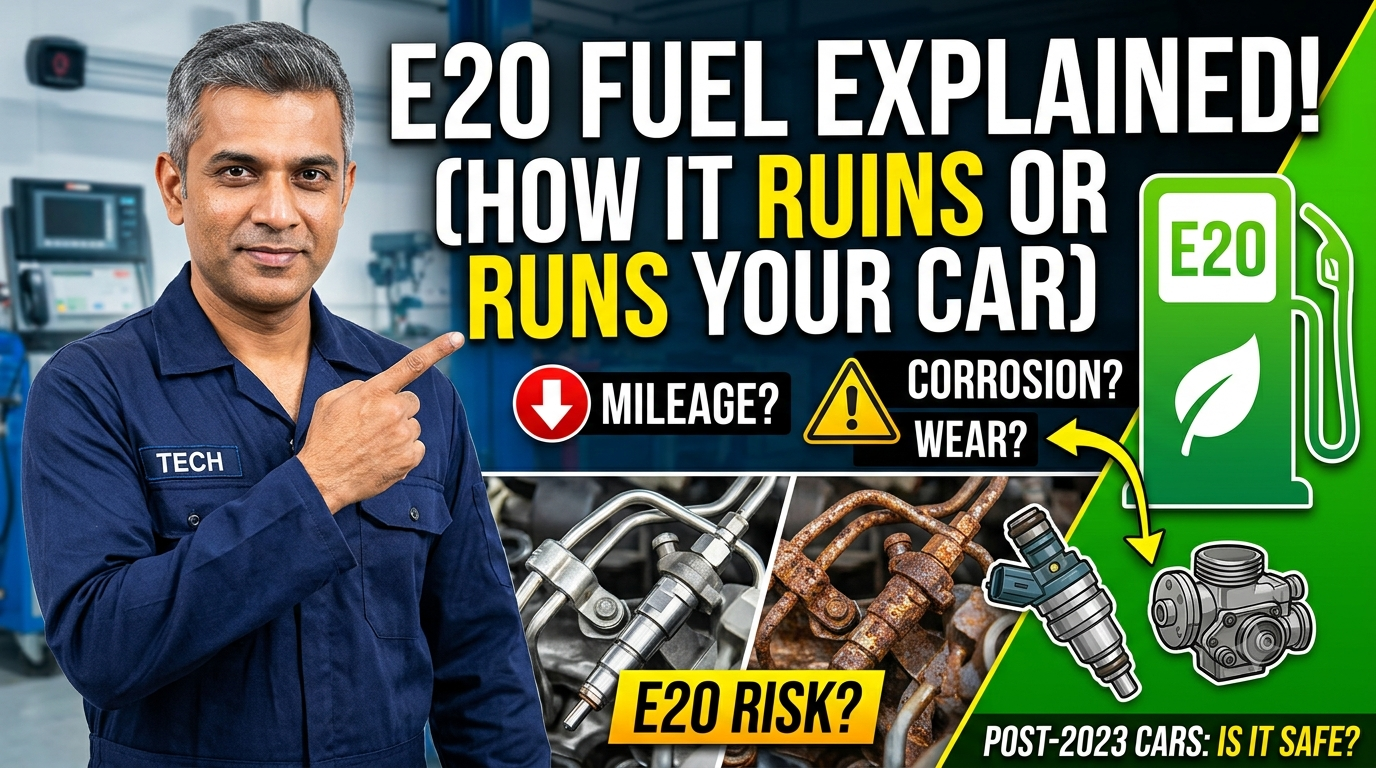
Ethanol is highly hygroscopic (it readily absorbs moisture from the air) and solvent. In older engines designed strictly for regular petrol, a high concentration of ethanol can corrode aluminum fuel lines, degrade rubber gaskets, and dry out plastic seals.
- Vehicles manufactured after 2023 are built with upgraded fuel systems (corrosion-resistant coatings, robust elastomers) to be fully E20 compliant.
- Older vehicles can safely run on standard E10 (10% blend) without issues, but regular use of E20 in non-compliant legacy engines may cause fuel system degradation over time.
Who Makes E20 Available in India?
E20 petrol is dispensed through the country’s all three major public sector oil marketing companies (OMCs):
- Indian Oil Corporation (IOCL)
- Bharat Petroleum (BPCL)
- Hindustan Petroleum (HPCL)
Private players like JioBP, Shell, Nayara also sell E20. As of the national rollout in April 2025, E20 is available at pumps across the country — not just in select cities. You can use each OMC’s official website or mobile app to find the nearest E20 pump.
Is E20 the End of the Road?
Far from it. The government has already signalled that E20 is not the finish line — it’s a milestone. A dedicated government committee is actively exploring pathways to push blending rates beyond 20%, with flex-fuel vehicles (capable of running on any blend from E0 to E100) expected to play a growing role in India’s automotive future.
Meanwhile, the broader energy transition continues — with biodiesel blending mandates, compressed biogas, and electric vehicles all forming part of India’s long-term strategy for sustainable mobility.
The Bottom Line
E20 petrol isn’t just a technical tweak to the fuel in your tank. It’s part of a fundamental shift in how India thinks about energy — moving away from expensive, polluting, imported crude oil toward domestically produced, renewable, cleaner-burning biofuels.
It saves foreign exchange. It cleans the air. It pays farmers. And for most modern vehicles, it works seamlessly.
If you drive a car or bike made in the last few years, chances are you’re already running on E20 without any issues. And if you’ve been wondering what the future of fuel looks like in India — this is it.